A100 vs H100 GPU Cloud (2026): Which Should You Rent?
Explore the differences between A100 and H100 GPUs in cloud environments to decide the best option for your AI workloads.
The A100 and H100 GPUs represent two of the most advanced offerings in the realm of cloud-based computing for AI workloads. As AI engineers seek to optimize their resources for machine learning, understanding the distinctions between these GPU types can significantly impact performance, cost, and suitability for specific tasks. This article provides a head-to-head comparison of cloud services that offer A100 and H100 GPUs, focusing on key aspects such as pricing, performance, and use cases.
Pricing Overview
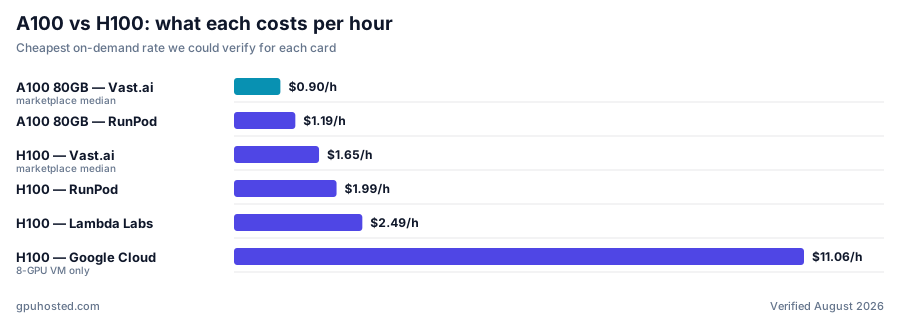
The pricing for renting A100 and H100 GPUs varies significantly across different cloud providers. Here’s a comparative table to illustrate the options available:
| Provider | GPU | From (A100 / H100) | Locations | Best For |
|---|---|---|---|---|
| RunPod | A100 80GB · H100 PCIe | $1.19/h · $1.99/h | US, EU, CA | Fine-tuning LLMs, Stable Diffusion, training |
| Lambda Labs | A100 40GB · H100 PCIe | $1.10/h · $2.49/h | US, AU | LLM training, research, fine-tuning |
| CoreWeave | A100 · HGX H100 | $2.70/h · $6.16/h | US, EU | Large-scale training, foundation models |
| Google Cloud | A100 40GB · H100 80GB | $3.67/h · $11.06/h | US, EU, APAC | TensorFlow workloads, enterprise AI |
| Azure | A100 80GB · H100 ×8 | $4.10/h · $98.32/h | US, EU, APAC | Azure ML pipelines, Microsoft-stack AI |
| AWS | A100 ×8 · H100 ×8 | $32.77/h · $98.32/h | US, EU, APAC | Enterprise MLOps, production inference |
These are the rates for the two cards this page compares, not each provider’s cheapest SKU — an entry price on an RTX card tells you nothing about what an H100 hour costs. CoreWeave and AWS sell H100 only in 8-GPU nodes; their per-GPU equivalents are $6.16 and $12.29.
Key Points on Pricing
- RunPod offers the most economical option starting at $0.16/h, but is primarily focused on community GPUs, which may not be as reliable.
- Lambda Labs provides on-demand A100 and H100 GPUs with a solid reputation for availability and fast setup, starting from $0.69/h.
- CoreWeave specializes in H100 GPUs for large-scale applications, but at a higher price point, reflecting its enterprise-level services.
- Google Cloud GPU, while offering robust integration with TensorFlow, comes at a premium price, making it less attractive for budget-conscious users.
- Both AWS GPU (EC2) and Azure GPU provide competitive pricing starting at $0.526/h, catering to enterprise needs, although their A100 and H100 on-demand pricing can be steep.
Performance Considerations
A100 vs H100 Architecture
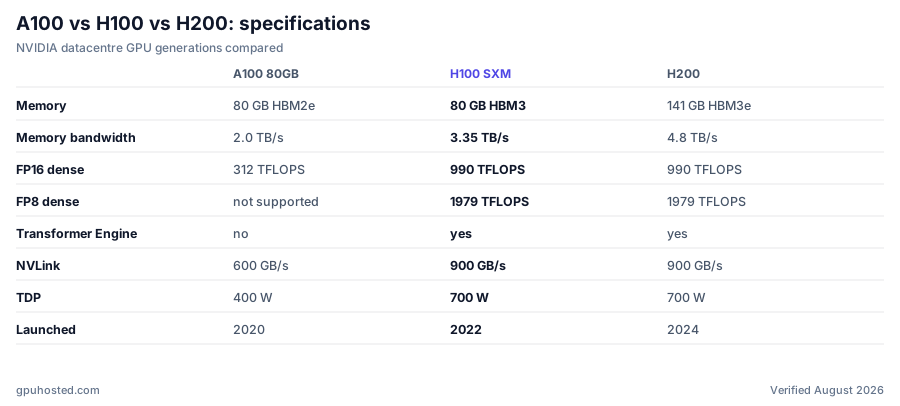
The A100 GPU is built on NVIDIA’s Ampere architecture, providing excellent performance for training and inference tasks, especially for large language models (LLMs). It features:
- 40GB or 80GB of high-bandwidth memory (HBM).
- Support for multi-instance GPU (MIG) technology, allowing multiple workloads to run simultaneously.
The H100 GPU, on the other hand, is based on the newer Hopper architecture, which brings significant improvements:
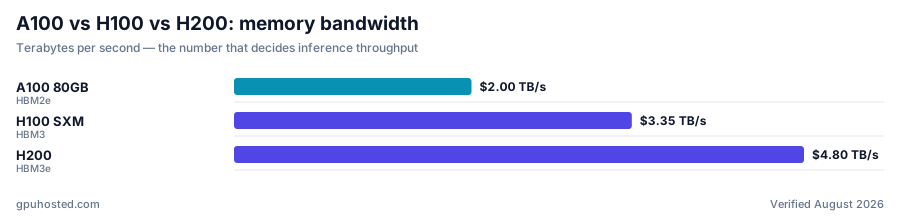
- Enhanced memory bandwidth and compute capabilities.
- Advanced features like Transformer Engine, which optimizes AI model training and inference performance.
Use Cases for A100 and H100
- A100: Ideal for tasks such as fine-tuning LLMs and training complex models. Its widespread availability across various cloud platforms makes it a go-to choice for many engineers.
- H100: Suited for cutting-edge applications requiring maximum performance, particularly in large-scale training and foundation model development. Its features enable faster processing, making it a preferred choice for high-demand scenarios.
Provider Recommendations
For those considering A100 or H100 GPUs, the following providers stand out based on specific needs:
- RunPod: Best for budget-conscious users needing A100 GPUs for training tasks. Their pricing starts at an incredibly low rate of $0.16/h. Check them out here.
- Lambda Labs: Offers reliable access to both A100 and H100 GPUs, ideal for research and fine-tuning, with easy setup and fast access. More details can be found here.
- CoreWeave: If you need H100 GPUs for large-scale training, their multi-node performance is unmatched, although it requires an enterprise contract. Learn more here.
- Google Cloud GPU: Perfect for TensorFlow workloads and enterprises that need tight integration with other Google services, though it’s more expensive. Visit here.
- AWS GPU (EC2) and Azure GPU: Both are excellent choices for enterprise-level applications, offering robust services and integration with their respective ecosystems. Explore AWS here and Azure here.
FAQ
What is the primary difference between the A100 and H100 GPUs?
The primary difference lies in their architecture and performance capabilities. The A100 is built on NVIDIA’s Ampere architecture, making it suitable for a variety of AI workloads with strong multi-instance GPU capabilities. The H100, however, utilizes the newer Hopper architecture, which offers enhanced memory bandwidth and specialized features for training transformer models, leading to superior performance in large-scale AI applications.
Which cloud provider offers the best pricing for A100 and H100 GPUs?
For A100 GPUs, RunPod provides the most competitive pricing starting at $0.16/h, making it a great option for budget-conscious users. However, for H100 GPUs, Lambda Labs offers reliable service starting at $0.69/h, which is reasonable given the performance benefits. It’s essential to consider the specific workload requirements and reliability when choosing a provider.
Are there any limitations when using A100 or H100 GPUs in cloud environments?
Yes, there are some limitations. A100 GPUs tend to have better availability across various providers, while H100 GPUs may have limited access and higher costs in some cases. Additionally, while cloud providers like RunPod and Lambda Labs offer community and dedicated services respectively, community clouds may experience less reliability. Always assess the specific requirements of your workload and the reputation of the provider when selecting a GPU.
For a comprehensive overview of GPU cloud options, check out our full GPU cloud comparison.