RunPod Pricing 2026: GPU, Storage and Serverless Costs
Current RunPod Pod and Serverless GPU rates, storage fees, stopped-volume costs, billing rules and worked monthly examples, checked September 2026.
RunPod has three different compute products: Pods for dedicated instances, Serverless for request-driven inference, and Clusters for multi-node workloads. This guide focuses on current Pod rates, the storage charges that continue after some Pods stop, and the difference between Pod and Serverless billing.
Prices below were checked against RunPod’s official pricing page on 10 September 2026. Availability and rates can change by GPU and capacity, so confirm the console price before deploying.
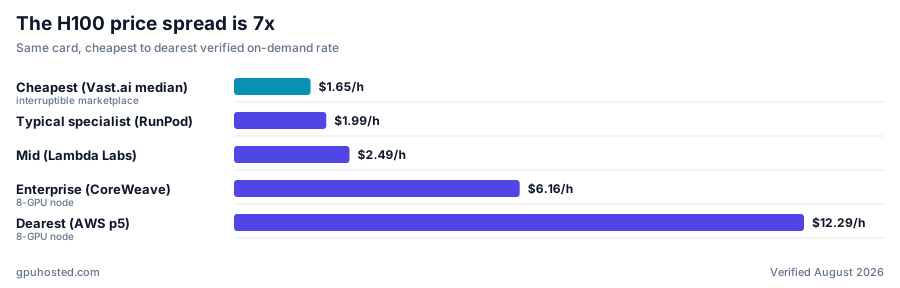
RunPod Pod GPU prices
| GPU | VRAM | Community Cloud | Secure Cloud | Practical fit |
|---|---|---|---|---|
| RTX A5000 | 24 GB | $0.16/h | $0.27/h | Entry experiments and smaller fine-tunes |
| RTX 3090 | 24 GB | $0.22/h | $0.50/h | Image generation and experiments |
| RTX A6000 | 48 GB | $0.33/h | $0.53/h | Budget 48 GB workloads |
| RTX 4090 | 24 GB | $0.34/h | $0.74/h | Fast image generation and inference |
| A40 | 48 GB | $0.35/h | $0.49/h | Cost-sensitive 48 GB workloads |
| L40S | 48 GB | $0.79/h | $1.09/h | Inference and fine-tuning |
| A100 PCIe | 80 GB | $1.19/h | $1.59/h | Large-model training and inference |
| A100 SXM | 80 GB | $1.39/h | $1.59/h | Bandwidth-sensitive training |
| H100 PCIe | 80 GB | $1.99/h | $2.89/h | High-throughput inference |
| H100 SXM | 80 GB | $2.69/h | $3.49/h | Foundation-model training |
| H200 | 141 GB | $3.59/h | $4.59/h | Larger models and long context |
RunPod’s Pod selection documentation describes Community Cloud as peer-to-peer infrastructure and Secure Cloud as T3 or T4 data-center infrastructure. RunPod says it is no longer accepting new Community Cloud hosts, although existing Community Cloud resources remain available.
Pod compute is billed by the second. An on-demand deployment requires enough account credit for at least one hour of the selected configuration, but that is a credit requirement, not an hourly billing minimum.
Storage and transfer costs
| Storage type | Running | Stopped | Persistence |
|---|---|---|---|
| Container disk | $0.10/GB/month | Not charged | Erased when the Pod stops |
| Volume disk | $0.10/GB/month | $0.20/GB/month | Retained until the Pod is deleted |
| Network volume below 1 TB | $0.07/GB/month | $0.07/GB/month | Portable between Pods |
| Network volume above 1 TB | $0.05/GB/month | $0.05/GB/month | Portable between Pods |
RunPod’s Pod billing documentation states that Pods have no data ingress or egress fee. Container and volume disks are billed by the second, while network volumes are billed hourly. The main cost trap is a stopped Pod with a persistent volume: compute stops, but the volume can continue at $0.20 per GB each month.
Example: a stopped Pod retaining a 100 GB volume costs about $20 for a full month even with no GPU compute. A 100 GB network volume below 1 TB costs about $7 per month.
Worked compute examples
The examples below multiply one GPU by the listed Community Cloud rate. They exclude storage and assume the selected GPU is available.
| GPU | 8-hour job | 160-hour work month | 730-hour continuous month |
|---|---|---|---|
| RTX A5000 at $0.16/h | $1.28 | $25.60 | $116.80 |
| H100 PCIe at $1.99/h | $15.92 | $318.40 | $1,452.70 |
| H200 at $3.59/h | $28.72 | $574.40 | $2,620.70 |
For a realistic monthly budget, use:
GPU hourly rate x running hours + storage rate x stored GB
A 160-hour H100 PCIe Community Cloud month with a 100 GB running volume is approximately $328.40: $318.40 compute plus $10 storage. Taxes, savings plans and availability are not included.
Pods versus Serverless pricing
Pods allocate a dedicated instance and charge while that Pod runs. RunPod’s Serverless billing documentation says Serverless is billed from worker start until the worker fully stops, rounded to the nearest second. That time includes container startup, request execution and the configured idle timeout. Serverless also charges for container or network storage.
The two products should not be compared with one headline GPU number. For sporadic API traffic, scale-to-zero Serverless can reduce idle compute. For an interactive notebook, training job or predictable long-running process, a Pod is the more direct unit to budget. See the RunPod Serverless pricing guide for worker classes and the cold-start cost model.
Savings plans
RunPod offers prepaid three-month and six-month savings plans for Pod compute. Storage remains billed at standard rates, including persistent storage on stopped Pods. Treat a savings plan as a commitment decision, not as the default on-demand price shown in the table above.
How to compare RunPod with another provider
Compare the same GPU model, VRAM, cloud tier, region and billing duration. Then add storage and any idle time. A provider-level starting price can otherwise compare an entry gaming GPU with a data-center H100 and produce a misleading winner.
For broader provider coverage, use the GPU cloud comparison.
Affiliate link: If you sign up through our RunPod link, GPUHosted may earn a commission at no extra cost to you. Check current RunPod availability and prices.
FAQ
What is the cheapest RunPod GPU in this snapshot?
The lowest rate in this checked table is $0.16 per hour for an RTX A5000 on Community Cloud. The same GPU is listed at $0.27 per hour on Secure Cloud. Live availability can differ, so verify the console before deployment.
Does RunPod charge for data transfer?
RunPod’s Pod pricing documentation states that there are no fees for data ingress or egress. Storage is separate and can continue to accrue when a Pod is stopped.
Does a stopped RunPod still cost money?
GPU compute stops, but persistent storage may continue. A volume disk is listed at $0.20 per GB per month while stopped. Network volumes keep their listed storage rate. Container disks are erased when the Pod stops and are not charged in the stopped state.
How is RunPod Serverless billed?
Serverless is billed per second from worker start until full stop, including startup, execution and idle timeout. The final rate depends on worker class and GPU memory tier, and storage is billed separately.
Is Community Cloud the same as Secure Cloud?
No. RunPod describes Community Cloud as peer-to-peer infrastructure and Secure Cloud as T3 or T4 data-center infrastructure. The price and availability can differ for the same GPU.